

ChatGPT Astra can support digital marketing by helping you research a market, structure content, develop ad ideas and interpret campaign data. The useful question is where it improves a real decision—and what a marketer still needs to check.
This guide connects GPT-6 Astra to practical SEO, Meta Ads and website workflows. The examples are proposed ways to use AI, not promises of higher rankings or campaign results.
By Yousaf Saneen · Published 8 October 2026 · Product references checked on 8 October 2026 · AI-assisted educational article.
What is ChatGPT Astra?
In this article, “ChatGPT Astra” refers to OpenAI’s GPT-6 Astra model. OpenAI’s documentation describes it as a model for demanding reasoning, research, coding, computer use and document creation. The underlying model and the tools available in a particular ChatGPT account are separate things: an API capability does not mean every chat has the same access. See the official GPT-6 Astra model documentation.
For marketers, those capabilities suggest ways to organise research, compare messages and work through complex briefs. They do not make Astra an independent source of market truth. Give it current evidence, a specific objective and clear boundaries. Check the model and tools available in your own account before planning a workflow around them.
Five useful ways to use ChatGPT Astra in digital marketing
1. Turn audience research into a usable brief
A strong campaign starts with understanding why a person would choose your offer. Bring together approved customer feedback, sales-team observations, product details and public competitor pages. Ask Astra to group recurring questions, identify objections and distinguish supported findings from assumptions.
For an education business, the brief might separate parents asking about teaching quality from parents concerned about class timings or follow-up. Those concerns lead to different messages. Avoid letting AI invent customer interviews, personas presented as research, or market-size figures.
Useful output: an audience brief with an evidence column, an open-questions column and three testable message angles.
2. Build SEO content around search intent
Use Astra to organise topics around what the reader needs to accomplish. A person searching “how to reduce lead cost” needs a diagnostic explanation; someone searching for a consultant needs services, evidence and a clear next step. The pages should serve those different needs.
Supply Search Console queries, the page’s purpose and verified business details. Ask for a content outline, missing questions, internal-link opportunities and title alternatives. Then check the current search results yourself. AI suggestions alone do not establish keyword demand, competition or search intent.
Google explains that generative AI can help with research and structure, while generating many pages without adding value may violate its scaled content abuse policy. Keep each article useful, accurate and specific to its audience. Read Google Search’s guidance on generative AI content.
Useful output: a focused article brief with reader questions, original examples, supporting sources and a relevant call to action.
3. Develop Meta Ads creative hypotheses
Astra can help you explore different ways to communicate one verified offer. Give it the audience, the offer, approved benefits, existing creative and restrictions. Ask for distinct concepts rather than ten versions of the same opening line.
For example, one concept could answer a common objection, another could demonstrate the service, and a third could explain the next step after an enquiry. Each concept should have a hypothesis: what belief might change, and which observable behaviour would suggest it worked?
Review every claim, testimonial and visual before launch. Judge creative by the campaign’s actual objective. More video plays or a stronger hook rate can be useful signals, but they do not establish lead quality or sales.
Useful output: a creative test plan with an angle, a verified proof point, a proposed opening and a success measure.
4. Interpret performance without confusing metrics
Use an approved, anonymised export to ask better questions about a campaign. Include the reporting dates, attribution settings, objective and definitions of each result. Ask Astra to show its calculations and flag missing information.
A lead form, a messaging conversation and a qualified sales enquiry are different events. Combining them into one “leads” total without an explanation can hide quality differences or duplicates. Compare like with like, then connect platform results to your sales records.
For a simple example, ₹20,000 spent on 250 form submissions gives a cost per submission of ₹80. If the sales team qualifies 50 of them, the cost per qualified lead is ₹400. This is an illustrative calculation, not a client result. The second number may be more useful for deciding what to change.
Useful output: a short diagnostic report separating observations, possible explanations and the next checks needed.
5. Improve landing-page clarity
Give Astra the landing-page copy, campaign message and desired action. Ask whether the headline matches the ad, whether the offer is understandable and whether important questions remain unanswered. It can propose clearer headings, a better section order and more specific button labels.
A copy review should be followed by a real page check: mobile readability, form behaviour, loading speed, navigation and keyboard access. A persuasive draft does not prove the page is technically sound. Explore my digital marketing and website services for support with the wider journey.
Example: planning an education campaign for Kerala and GCC parents
Consider an education provider that wants enquiries from parents in Kerala and the GCC. This hypothetical example shows how to organise the work without treating AI-generated assumptions as customer research.
- Prepare the facts: the course, age range, delivery format, available class times, fees and permitted claims.
- Separate the audiences: document location, language preferences and known scheduling needs. Confirm these with actual customer information rather than stereotypes.
- Ask for message options: compare teaching support, convenience and progress visibility as potential angles. Identify which claims need evidence.
- Check the enquiry journey: explain who responds, when they respond and what information a parent receives next.
- Run a controlled test: document what changes between creatives and avoid drawing conclusions from a tiny sample.
- Review sales feedback: track qualification, follow-up and enrolments alongside platform metrics.
The value comes from connecting the ad, landing page and sales process. AI can help organise that thinking; the business supplies the evidence and takes responsibility for the decisions. For a real example of campaign reporting, see my EdTech client case study from Kerala.
Three ChatGPT Astra prompts for marketers
These templates use ordinary language. Replace the bracketed parts with your own approved information. OpenAI’s prompt engineering guidance supports giving clear instructions and relevant context; the marketing templates below are original examples.
SEO content brief
Create a content brief for [topic] aimed at [audience]. The reader wants to [task]. Use these verified business facts and supplied search observations: [details]. Suggest one main heading, a logical section order, questions to answer and relevant internal links from [list]. Separate facts from assumptions. Do not invent search volumes, rankings, testimonials or statistics.
Campaign analysis
Analyse this anonymised campaign export for [date range]. The objective is [objective]. Define each result using [definitions]. Check totals and show the formulas for cost per result. Separate lead forms from messaging conversations. Identify three observations, three possible explanations and the additional data required before changing spend. Do not infer revenue or ROAS without sales data.
Creative testing plan
Develop three distinct Meta Ads concepts for [offer] and [audience]. Use only these approved claims: [claims]. For each concept, propose an opening, a supporting proof point, a call to action and a hypothesis to test. Flag any claim that needs verification. Do not fabricate urgency, reviews or guaranteed outcomes.
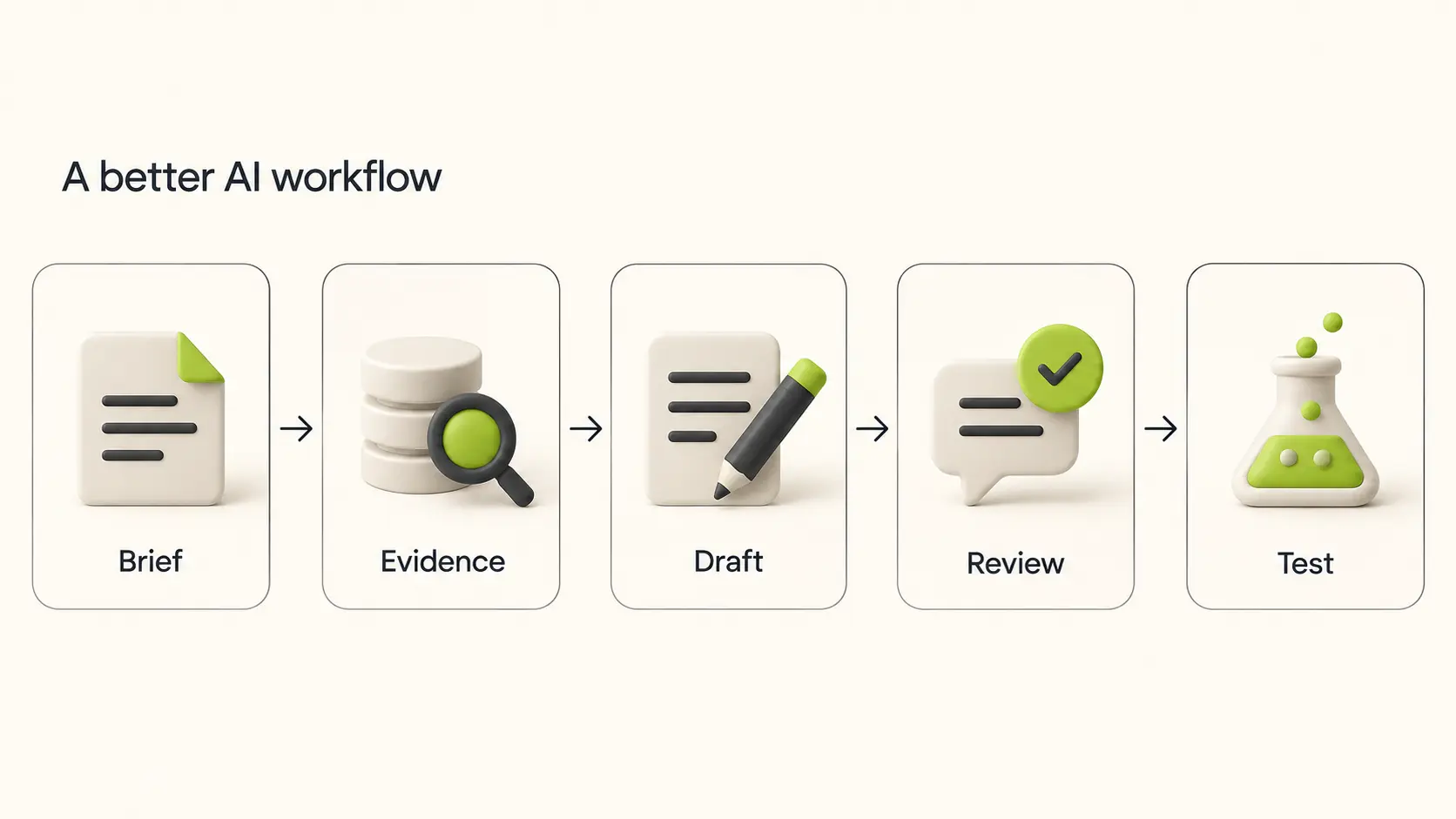
A practical workflow: brief, evidence, draft, review, test
Start with one repeatable task rather than handing over an entire marketing operation. Choose something where you can assess the output: a content brief, a reporting summary or a set of creative hypotheses.
- Brief: define the audience, objective, constraints and expected output.
- Evidence: provide current, relevant information and remove unnecessary personal data.
- Draft: ask for an organised first version with uncertainties clearly marked.
- Review: verify claims, calculations, sources, tone and brand suitability.
- Test: publish or launch the approved version, measure the outcome and record what you learn.
Keep credentials, identifiable customer records and confidential client material out of a general chat unless your organisation has approved the destination and access. Use aggregated or anonymised data wherever practical. A model’s ability to work with information does not grant permission to share it.
Measure useful outcomes: less editing time, clearer decisions, fewer reporting errors or better-qualified enquiries. Do not label AI successful simply because it produced more content. Keep spending decisions, factual claims and final publication under human review.
Frequently asked questions
Can ChatGPT Astra improve SEO rankings?
It can support research, structure and editing. Rankings depend on the usefulness of the page and many other factors. AI-written copy, keyword repetition and a high optimisation score do not guarantee visibility.
Can it manage Meta Ads automatically?
Do not assume an ordinary chat can access or operate your ad account. Tools, integrations and permissions determine what a particular setup can do. The workflows here focus on preparation and analysis, with campaign changes reviewed by a marketer.
Does it replace a digital marketing consultant?
AI can help with parts of the work. Someone still needs to understand the business, verify evidence, choose the strategy and connect marketing activity to sales. Use it to support that responsibility.
Is AI-assisted blog content acceptable for Google?
Google’s guidance focuses on useful content and warns against scaled content created without added value. Review the article for accuracy, originality and relevance instead of treating the production method as a ranking shortcut.
Make AI useful to your marketing
ChatGPT Astra is most useful when it helps you move from a vague question to a clear, evidence-based next step. Start with one task, document your inputs, review the output and measure the result.
If you want to connect AI-assisted work with SEO, paid campaigns and a stronger website journey, start a conversation about your marketing. You can also learn more about my background or return to all Insights.
Editorial note: This educational article was prepared with AI assistance for Yousaf Saneen’s Insights. Product facts link to official documentation. Prompts and campaign scenarios are illustrative, and no Astra-related client results are claimed. The cover artwork is an original AI-generated conceptual illustration, not an OpenAI product screenshot.